Founder Strategy
The 15 GTM Problems Founders Must Recognize
Mar 1, 2026
written by:
Chelsea Tiner

Functional leaders experience these problems every day: churn, POV, prioritization. Boards and CEOs, though, experience them differently: as big-picture “Valleys of Death” that threaten growth.
The disconnect often creates finger-pointing. “It’s sales’ fault. It’s marketing’s fault.”
Here’s the truth: these problems are not functional failures—they’re GTM failures.
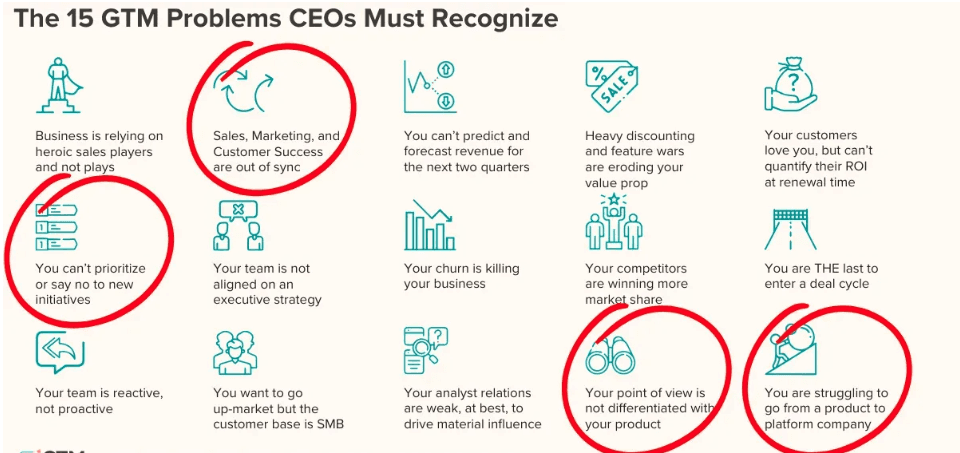
1. Your Point of View Isn’t Differentiated
The problem: If your messaging sounds like everyone else’s, buyers have no reason to listen.
Who gets blamed: Marketing takes the hit—“We need a better tagline” or “Demand gen isn’t working.”
The reality: Differentiation comes from a clear company purpose, a defined “enemy,” and explicit competitive advantages. That requires input from Product (what’s unique), Sales (what resonates), and CS (what customers actually value).
Diagnostic question to ask:
If you asked 10 people in your company what you do, would you get the same answer?
2. You’re Struggling to Go from a Product Company to a Platform Company
The problem: You’ve built a strong product, but growth stalls when customers don’t see the bigger platform vision.
Who gets blamed: Product—“We need more features, integrations, or categories.”
The reality: Moving from product to platform is a GTM challenge, not a product problem. Marketing needs to reframe positioning, Sales must sell the vision, and CS has to reinforce multi-persona value.
Diagnostic question to ask: Does your platform expansion require new personas? Or are you simply adding more features for the same buyer?
Your next move: Treat expansion into new personas or categories like starting a new business. Don’t assume existing awareness will carry you.
3. Sales, Marketing, and CS Are Out of Sync
The problem: Customers feel the seams when GTM teams act like separate planets.
Who gets blamed: Sales blames Marketing for bad leads. Marketing blames Sales for not following up. CS gets sidelined until renewal.
The reality: This is an executive alignment issue, not a pipeline issue. Without clarity on ICP, account lists, and shared goals, everyone creates their own version of success.
Diagnostic question to ask: How would Sales describe their relationship with Marketing? How would CS describe their relationship with Sales?
Your next move: Establish a single source of truth: ICP, pipeline contribution goals, and a unified GTM scorecard. Customers should feel one motion, not three.
5 questions to diagnose why sales, marketing, and CS are out of sync.
4. You Can’t Prioritize or Say No to New Initiates
The problem: The team is drowning in ideas, requests, and pet projects.
Who gets blamed: Marketing for moving too slow, Product for backlog delays, or Ops for “blocking.”
The reality: Prioritization is an executive function. Without a decision framework, functional teams spin up their own metrics and chase shiny objects.
Diagnostic question to ask: Does your planning process provide clarity, alignment, and team accountability—or just a long list of “good ideas”?
Your next move: Limit your executive scorecard to no more than 25 metrics. Sequence opportunities instead of trying to chase them all.